
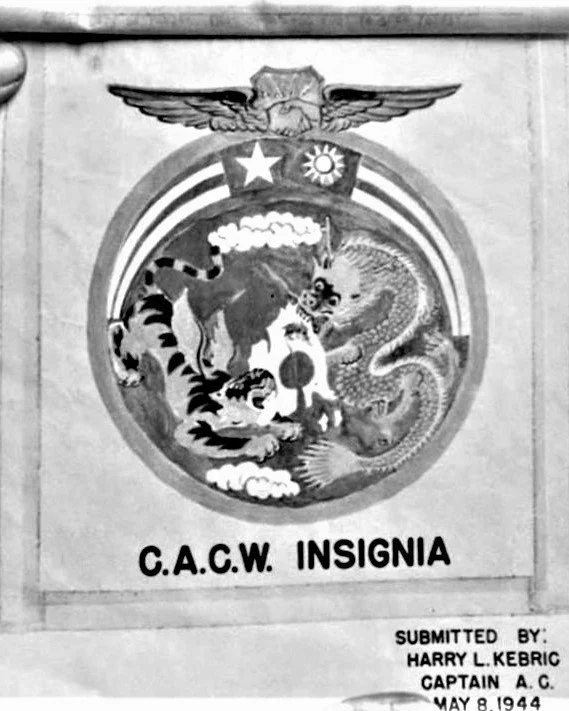
CACW Insignia: Symbol of Binational Alliance
It wasn’t until the year following activation of the Chinese-American Composite Wing that this one-of-a-kind unit adopted an insignia symbolizing its distinctive binational character. It featured an American “Flying Tiger” and a traditional Chinese dragon, shown symbolically destroying a “rising sun” flag that represented imperial Japan, their common enemy. Its design aptly reflected Maj. Gen. Claire Lee Chennault’s determination to provide good will and understanding between the Chinese and Americans for the future, as well as the CACW’s stated mission, "to train Chinese Air Force personnel in all phases of combat operations including maintenance and administration."

Kweilin Falls to ICHIGO
B-25s assigned to the 3rd Bomb Squadron crossed “the Hump” and then made their way to Kweilin. The planes arrived at their new base on September 8, 1944—the same day the Japanese 11th Army overran Lingling, both the town and the airfield, as part of their massive Operation ICHIGO offensive. Then began their advance toward Kweilin, about 125 miles farther to the southwest. The 3rd Squadron's bombers flew only four missions before Kweilin was evacuated, all against towns in the path of the enemy drive. Final evacuation and demolition procedures began on September 14, as 3rd Squadron personnel began their move to Peishiyi by air transport, railroad, truck convoy, and the squadron’s B-25s.

Jing Baos at Kweilin
After spending the summer of 1944 bombing Japanese facilities in Burma, personnel of the Chinese-American Composite Wing’s 3rd Bomb Squadron finally began the transfer to China. Chinese and American ground crews crossed “the Hump” and moved on to Kweilin (Guilin) in late August. No Japanese planes struck in the vicinity of Kweilin during the day but "they did keep us in the foxholes night after night," according to a service publication. Barracks boys shouted the warning jing bao! ("air raid") as they ran from room to room, turning off lights and banging on wash basins to wake anyone who may have slept through the warning siren. The threat soon became more dire. On September 8, as the squadron’s B-25s were completing the move, the Japanese 11th Army overran Lingling, only 125 miles farther to the northeast. Then began their advance toward Kweilin.

Flying “the Hump”
On August 26, 1944, members of the 3rd Bomb Squadron flew "the Hump" of the treacherous Himalayas, making the move from Chabua in Assam, India, to Kweilin (Guilin) in Kwangsi (Guangxi) Province, China. Flying the Hump took planes over rugged terrain, often through violent storms, sudden down drafts, and snow and ice at higher altitudes. It was some of the most dangerous flying in the world―so dangerous, in fact, that every flight over the Hump was logged as a combat mission. The planes all made it across safely, and squadron personnel arrived at their new base on September 1.