
CACW Insignia: Symbol of Binational Alliance
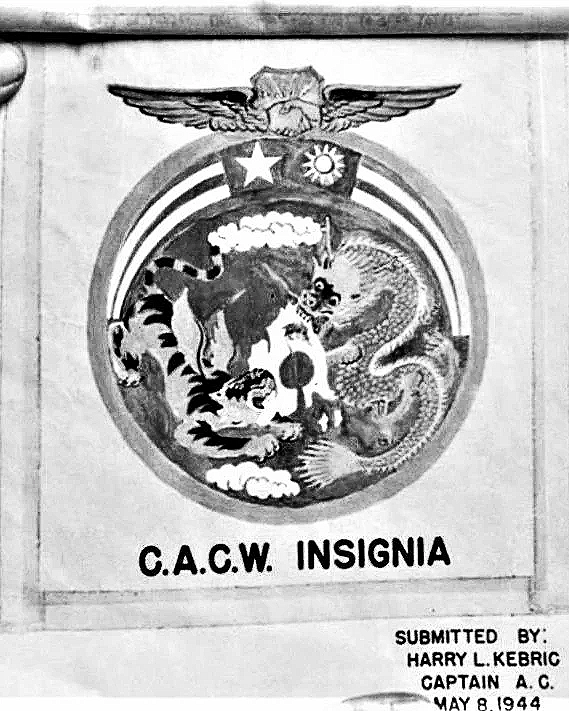
Captain Harry L. Kebric’s original concept of an insignia for the Chinese-American Composite Wing symbolized its unique binational character. It featured a “Flying Tiger” that represented the 14th Air Force, acting in cooperation with a traditional Chinese dragon to obliterate a flag that represented imperial Japan, their common enemy. The design was accepted by the Wing Insignia Selection Committee before being passed on to the War Department for final approval.
It is coincidental that Kebric’s design was submitted on the same date victory against Axis forces was declared in Europe. There would be three more months of intense combat in China before the Japanese finally admitted defeat.
National Archives and Records Administration
“Of all the maverick units that have enlivened the history of air combat, one of the least-known was created in 1943 as part of Claire Chennault's Fourteenth Air Force. Binational, bilingual, and eventually bisected by China's internal power struggle, it was the Chinese-American Composite Wing.
“Every airpower buff knows about the Lafayette Escadrille and the Eagle Squadron and the AVG, maverick units in which Americans in two world wars flew for foreign nations. All three have been repeatedly glamorized and publicized by books and films and magazine pieces.
“To say that is intended in no way to deny them the glory they richly earned. But, except for a handful of aging warriors who served in it forty-odd years ago, hardly anyone has ever heard of the Chinese-American Composite Wing (CACW) of Claire Chennault's ragged Fourteenth Air Force in China Theater of World War II. And that's a great pity, because it was as maverick an outfit as ever existed, a totally unique [sic] binational mixed fighter and bomber wing in which Americans and Chinese flew together against the Japanese.
“The Fourteenth was about as starved as the AVG had been, relying wholly for fuel, ammo, and spares on ATC cargo planes flying the Himalayan Hump. Despite the shortages, the Fourteenth achieved a spectacular kill ratio against the Japanese, due in no small measure to the brilliant air-to-air tactics the leather-faced Chennault drilled into his pilots. But successful as the Fourteenth was, it was powerless to halt Japan's ground advance across China, and no one knew it better than Chiang Kai-shek [China’s Nationalist leader]. The Fourteenth needed to be augmented by a new, revitalized Chinese Air Force, he believed, and in the spring of 1943, he sent Chennault to Washington to plead his case for one.
“The timing was right. China loomed large in American strategic thinking at that stage of the war. Many planners believed that the final assault on the Japanese home islands, considered a prerequisite to final victory, would have to be launched from the Chinese mainland. Keeping China in the war until that time was mandatory, and a combat-worthy Chinese Air Force, helping the Fourteenth contain Japan's China-based air, would be an invaluable asset. Generals Hap Arnold and George C. Marshall listened to Chennault's presentation of Chiang Kai-shek's proposals and bought them. The CACW was born.”
Ex-CBI Roundup
July 1976 Issue
By Lt. Col.Kenneth Kay, USAF (Retired)
Reprinted from AIR FORCE Magazine
The Chinese-American Composite Wing (Provisional), unlike any other military organization in the world, was formally activated at Malir on October 1, 1943. It was “composite” in that its aircraft comprised both fighters and bombers. Although designated as a wing, it never flew as a single unit; instead, its operational units were often billeted at bases located hundreds of miles apart across India and China. The CACW eventually consisted of the 1st Bombardment Group equipped with B-25 Mitchells (two-engine medium bombers) and the 3rd and 5th Fighter Groups equipped with P-40s, many of them painted with the iconic "shark mouth" of the original Flying Tigers of Chennault’s American Volunteer Group.
Each group was made up of four squadrons: the 1st Bomb Group of the 1st, 2nd, 3rd, and 4th Bomb Squadrons; the 3rd Fighter Group of the 7th, 8th, 28th, and 32nd Fighter Squadrons; and the 5th Fighter Group of the 17th, 26th, 27th, and 29th Fighter Squadrons. These were existing Republic of China Air Force squadrons that had been assigned to the CACW and reorganized according to American military standards. Duplicate Chinese and American commands were established for both bomber and fighter groups. The CACW's planes and other equipment were supplied through Lend-Lease, a program that supplied materiel and services to America's Allies.
Chinese pilots, bombardiers, and navigators were trained in the United States before returning for service in the CACW which, although officially part of the Chinese Air Force, was administratively assigned to the 14th Air Force. These airmen, many who had been recruited as students at Chinese universities, were "the cream" and took great pride in being chosen for this elite organization. The wing's operational units, fighter and bombardment, were jointly commanded by both American and Chinese Air Force officers, and its aircraft were jointly manned by American and Chinese pilots and aircrewmen. Because CACW aircraft were owned by the Chinese, its planes bore the Chinese Nationalist emblem, the blue and white twelve-pointed Kuomintang sun.
A binational unit such as this had never been attempted before. An Air Force press release found among CACW records explained the concept. “In the composite wing, Americans will not fight as units for the Chinese air force as the AVG did, but actually fly side by side with the Chinese.” It explained that some planes would have American pilots with Chinese crews, but most would be flown by all-Chinese crews. “Occasionally, an American will be in the lead element, at other times in the wing elements, the idea being to give the Chinese squadron and group leaders the latest ‘know-how’ in tactics with American aircraft and to give them training in actual combat under the best American direction.”
Chennault's plan was for one bombardment squadron to be trained simultaneously with two fighter squadrons over a period of six weeks, with the Americans acting as mentors to the Chinese. When those three squadrons had completed their training, they would be sent to China as three additional squadrons began training. This would continue until a bombardment group of four squadrons and two fighter groups with four squadrons each had been brought to combat readiness. Group after group of Chinese and American pilots and crews came into Malir Field, a sub-base of the main air base at Karachi (then in India, now Pakistan) from China and America. These men spent hundreds of hours flying B-25s and P-40s and in studying military tactics, motors, and equipment. American GIs in khaki fatigues worked side by side in a cordial atmosphere with the Chinese, clad in their dark blue work suits.
This hitherto untried experiment of coordinating the efforts of two widely-dissimilar national groups was not without challenges. Differing languages presented the most obvious and immediate difficulty, but complete disparities in ideology, philosophy, and culture also had to be addressed. “The blunt American manners clashed sharply with the Chinese ideas on face saving and both Chinese and Americans found they had to modify their manners in order to get good results. Many Chinese pilots had to be persuaded that it was not cowardly to bail out of a badly damaged plane and that crashing with their plane served no purpose,” according to a CACW report written early in the venture.
Maj. Don Hummel, formerly an attorney in Tucson and now Wing intelligence officer as well as historical officer, explained: “We mess around a bit in the wide chasm between two languages and two civilizations, but on the whole, we get along beautifully and are saved by a sense of humor on both sides for our mutual blunderings.” He blamed the contrast between the Americans’ drive and need for immediate results with the Chinese tradition of patience and “politeness” for the misunderstandings that did occasionally arise. Although both nationalities made efforts to accommodate their counterparts in the interest of achieving a common goal, some problems remained unresolved at the end of the war.
It wasn’t until the year following its activation that this unit adopted an insignia symbolizing its distinctive binational alliance. Its design aptly reflected Maj. Gen. Chennault’s determination to provide good will and understanding between the Chinese and Americans for the future, as well as the CACW’s stated mission, "to train Chinese Air Force personnel in all phases of combat operations including maintenance and administration."
On June 15, 1944, the long history behind the adoption of an authoritative CACW insignia came to its successful conclusion. As far back as late March it had been planned to adopt an insignia for the CACW. By late May a design submitted by Capt. Harry L. Kebric, CACW combat liaison officer, had been tentatively adopted. To make the dragon in his design look less reluctant, and to get a typical Chinese dragon into the composition, Capt. Kebric had the design further developed by Mr. Chen Yen Chian, an artist on the staff of the Kweilin Office of War Information (OWI). This improved design, adopted at the June 15 meeting of the Wing Insignia Selection Committee, was submitted, through channels, to the War Board for final approval.
Maj. Hummel explained the significance of each element:
The new Wing insignia and its symbolic significance might be described as follows: Centered in a blue, gold-bordered field, in bold relief against the blue background, are shown the gold Chinese dragon, representative of the Chinese Air Forces, and a tawnish winged tiger, symbolizing the 14th U. S. Air Force. Between them, tooth and nail, they tear to shreds the Japanese flag, this signifying their joint objective, the ultimate victory over the common foe. Slight cloud forms in this blue field further symbolize the air, the operating medium of the air forces. Above the blue field, the red and white stripes arching down over the top half of the insignia are representative of the colors common to the flags of both nations. The symbolical flag is further developed by the blue of the keystone set in the top center of the striped arch; while the white sun and the white star set beside each other in the keystone indicate the aircraft symbols used by the two nations. Surmounting all, two golden, winged hands are clasped in a firm, hearty grip, and are intended to represent the hand of the CACW Chinese airman and the hand of a CACW American airman, gripped in mutual support and confidence.
Chennault wrote soon after the unit’s formation: "The work of the CACW has been extremely good. The Chinese members of the wing have more than justified the confidence placed in them. They are eager to fight the enemy and have shown good combat discipline and effectiveness both in air combat and bombing." By the end of the war in China, Chinese and American aircrews were frequently flying missions that comprised single-nationality personnel. Despite some problems that persisted through the CACW’s existence, the bond that united them remained strong.
The month of September 1945 marked the final period of the CACW’s existence. “Almost two years of operations were climaxed in August by the sudden ending of the war, thus bringing about the disbanding of the Chinese American Composite Wing. This unique unit was formed with the intention of having Americans in it who would work in close cooperation with the Chinese members of the organization and who would train them in all phases of operations,” wrote the 1st Bomb Group adjutant (acting as historical officer). “That we were successful in welding together a striking force that wreaked havoc with Japanese supply lines, personnel, and military installations is self-evident—our record speaks for itself.”
There is much more to learn about the intriguing history of this one-of-a-kind outfit. You can find it in The Spray and Pray Squadron: 3rd Bomb Squadron, 1st Bomb Group, Chinese-American Composite Wing in World War II. It’s available from most online book vendors. Order it today!