
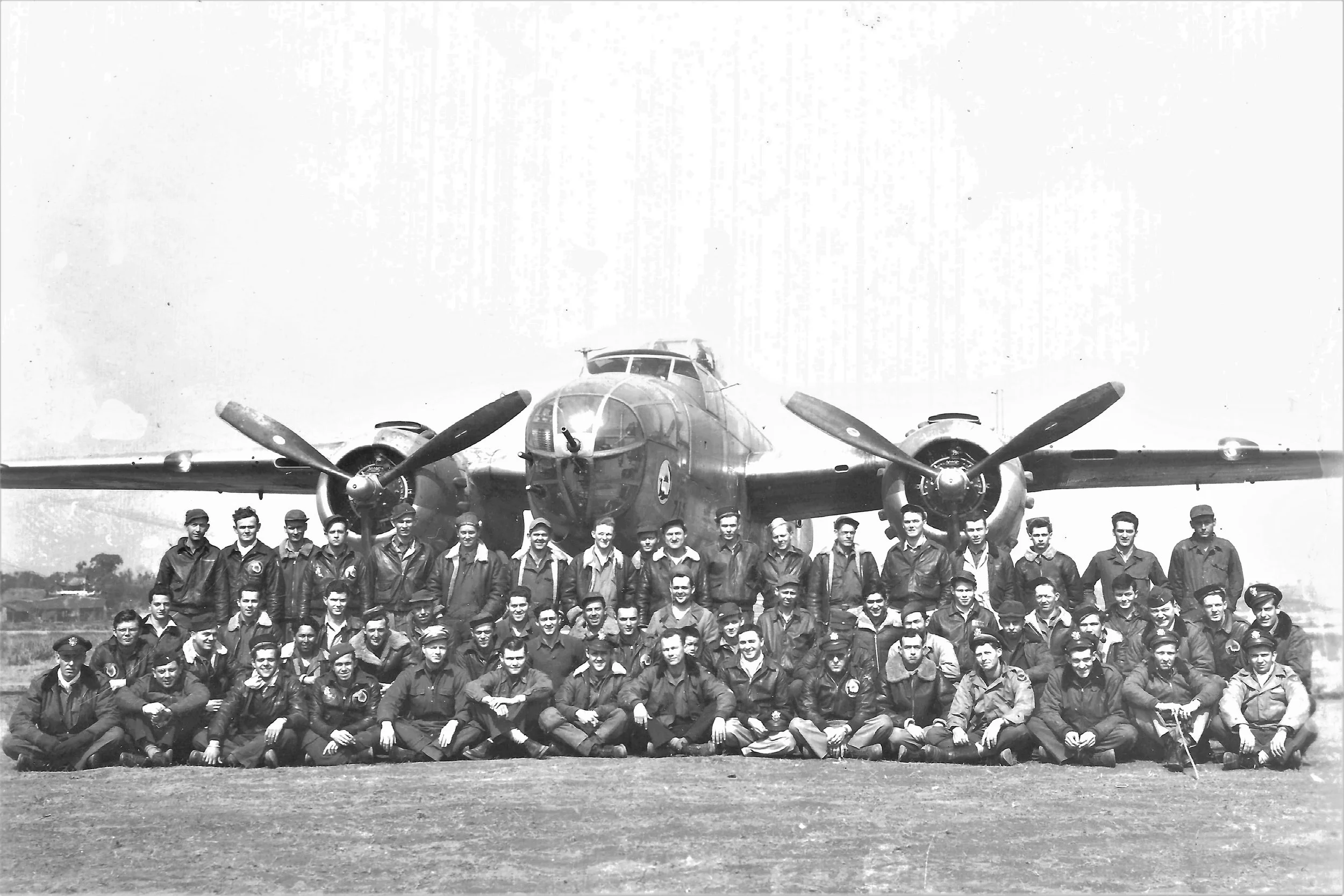
“Under Sterling Leadership”
On March 1, 1945, personnel of the Chinese-American Composite Wing’s 3rd Bomb Squadron stationed at Liangshan assembled on the field and posed for photographs. In position behind them was A/C #714, considered to be "the least shot up" of the squadron’s B-25Js. The first photo included all but a few of the Americans assigned at that time, and then they separated for pictures of only the officers, only enlisted men, and the softball team. These photos represented a significant event: the squadron’s transition in leadership. Major Mark T. Seacrest and Captain Jack M. Hamilton, the outgoing and incoming commanding officers, were pictured together. Both men served with distinction and represented the highest level of excellence in command.

Railroads and Rest Camp
After the loss of the 14th Air Force base at Laohokow, Chihkiang (now Zhijiang) became the most easterly of the bases operated by the 14th Air Force. On April 10, 1945, the Japanese initiated an offensive that claimed the full attention of the 3rd and 4th Bomb Squadrons and the 5th Fighter Group stationed at Chihkiang. So successful was the opposition against enemy targets in the Chihkiang Campaign that it proved to be the last major offensive by the Japanese in China. Even as life-or-death operations were being conducted, the daily business of the squadron went on. “All the men who have been overseas for a rather long time, or those who seem to need a little diversion and rest, are being sent to Chengtu, several at a time, to enjoy the ‘almost stateside’ atmosphere, the good ‘American’ food, and the almost white creatures of feminine pulchritude.” Five 3rd Bomb Squadron enlisted men were the next to be sent in late April.