
“Under Sterling Leadership”
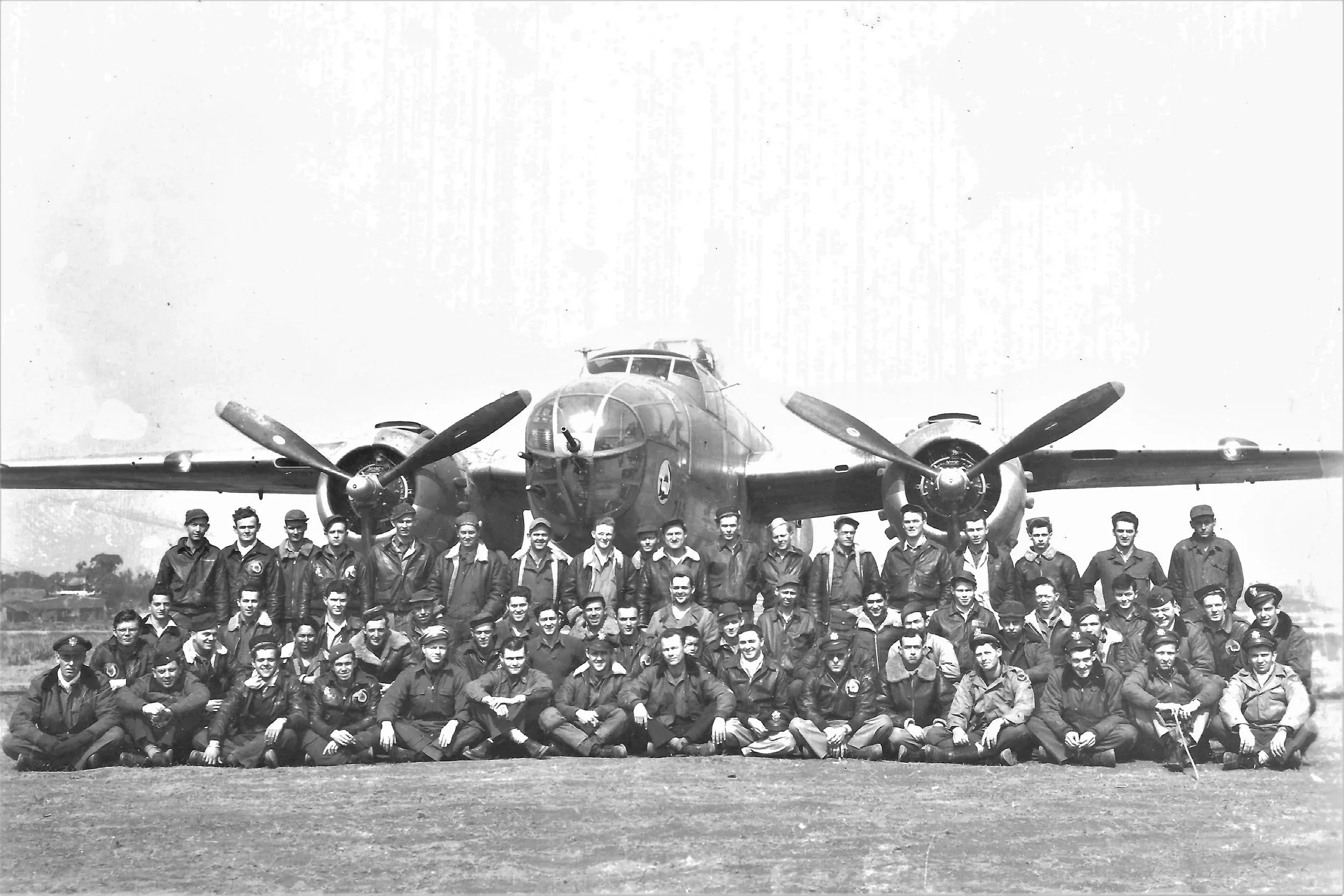
Maj. Mark T. Seacrest (front row, 6th from left) and Capt. Jack M. Hamilton (also front row, 8th from left) share this important moment of transition in leadership for the 3rd Bomb Squadron. Maj. Seacrest had received his orders to return to the US only days before, and Capt. Hamilton was preparing to assume command as his replacement. My dad, then-Sgt. James H. Mills, is standing below A/C #714’s “greenhouse nose” (8th from left). He remembered flying missions with both of these commanding officers and attested to their superior skills as pilots and as leaders. (I have identified all of the men pictured here and will share details with those who inquire via my website.) J. H. Mills collection
On March 1, 1945, personnel of the Chinese-American Composite Wing’s 3rd Bomb Squadron stationed at Liangshan assembled on the field and posed for photographs. In position behind them was A/C #714, serial #43-27809 (sometimes written as #43-2709), considered to be "the least shot up" of the squadron’s B-25Js. The first photo included all but a few of the Americans assigned at that time, and then they separated for pictures of only the officers, only enlisted men, and the softball team. TSgt. Robert N. Solyn kept copies but later explained that he did not appear in them because he was the photographer. An unidentified Chinese child was seated with them. He was perhaps one of several orphaned children who lived in an old kiln near the barracks. It was common practice for the tender-hearted Americans to “adopt” orphans in war-ravaged China.
This event represented a significant transition in leadership. Seated in the front row of this photo that includes officers and enlisted men are Major Mark T. Seacrest and Captain Jack M. Hamilton, the squadron’s outgoing and incoming commanding officers.
Maj. Seacrest had served as squadron CO since early January, when Maj. Chester M. Conrad unexpectedly received orders for his immediate return to "Uncle Sugar."* When Seacrest received his orders home on February 26, it came as no surprise since he had been put in rotation to go home soon before taking command.
Seacrest “certainly deserved to go home, for very few men in this theater can claim as impressive a record,” wrote 1Lt. Willard G. Ilefeldt, flight leader as well as historical officer.** Overseas since July 1943, Seacrest served with distinction in the 2nd (“Avengers”) Bomb Squadron before his reassignment to the 3rd Squadron, later becoming its operations officer. He had completed sixty-four combat missions and had 305 combat hours to his credit, and the amount of tonnage he had sunk while he was operating in the China Sea totaled among the highest of any B-25 pilot in any theater. He had been awarded the Air Medal with Oak Leaf Cluster and the Purple Heart. “Maj. Seacrest is indeed a resourceful combat pilot, for on several occasions, he has made as many as seven passes to knock out a very hot target, such as a Japanese gunboat. . . . Maj. Seacrest's exploits as a combat pilot are well known in this theater, and he leaves many admirers behind.”***
Capt. Hamilton, a recent addition to the squadron, was appointed as its commanding officer to replace Maj. Seacrest. He had joined the 3rd Bomb Squadron at about the same time that Seacrest assumed command. His extensive experience as a B-25 pilot/flight leader with the 489th Bomb Squadron, 340th (also “Avengers”) Bomb Group, 57th Bomb Wing of the 9th and later (from August 1943) 12th Air Force, more than qualified him for his role as commander.
Initially sent with the 489th to the Mediterranean Theater in March 1943 and stationed at El Kabrit, Egypt, he participated in primarily high-altitude bombing missions, both day and night, in support of the British 8th Army in Tunisia and Egypt. As Allied forces advanced, the squadron moved on to Italy, flying missions throughout Italy, Sicily, Yugoslavia, Albania, Bulgaria, and Greece. Its targets included airfields, railroads, bridges, road junctions, supply depots, gun emplacements, troop concentrations, marshaling yards, and factories.
On February 14, 1944, while operating out of Pompei, Hamilton completed his sixtieth combat mission, in the lead of a six-plane formation against the east choke point of marshaling yards about four miles southeast of Perugia, Italy, earning a seventh Oak Leaf Cluster to his Air Medal. He returned to the US the following month and was stationed for some period at Baltimore and later at Columbia. He had been in China since December 2.
When asked to compare the two theaters of operation, Hamilton’s response was recorded in the 3rd Squadron’s historical report. “The weather is always good in North Africa, while in China, the weather is always bad it seems.” The supply situation was much better in North Africa and “the intelligence set-up” was much more elaborate than in China, he said. “But however much better supplied and equipped North Africa was, the work that the Fourteenth Air Force has done and is doing, the tremendous obstacles it is overcoming in order to hit the enemy, the amount of energy expended to do the great task it is doing, is indeed greater than that of any other theater.”
Hamilton felt fortunate to have never been wounded in his three and a half years of service. The closest he had come was on a mission in North Africa when he brought in his crippled plane with forty-six holes in it.
A/C #714, shown in the March 1 photograph, was personalized soon after Hamilton assumed command as recognition of his expertise as a bomber pilot and his popularity among the men. Dubbed "Smilin' Jack" (hero aviator of the long-running comic strip) because of his cheerful disposition, his moniker had been painted below the window on the pilot's side of the cockpit. This bomber was first mentioned in mission reports while assigned to Task Force 34 (comprising detachments of the 3rd and 4th Bomb Squadrons) in November of the previous year. The aircraft again appeared in records on January 15, when Maj. Conrad led the 3rd Squadron element and Capt. Hamilton flew as his copilot on the successful Hankow Storage Area raid. It was Hamilton’s first mission in China.
Although it was designated as "his" plane, other operational officers took it up with equal frequency. That was the case on April 16. The plane was taking off on a raid when a tire blew out, tearing the undercarriage from beneath it and taking an engine with it. It then slid to a stop a short distance off the runway. Ilefeldt noted that A/C #714, "one of our newer planes,” was observed in “a rather unflyable condition on the side of the runway.” No injuries resulted from this incident. The bomber’s reusable parts were salvaged and its Chinese number reassigned to a replacement plane soon afterward.
When Major Hamilton (promoted on June 1) was awarded Chinese Air Force Wings on August 3, an article in his hometown newspaper stated, “A veteran pilot with 60 hard-earned missions . . . to his credit, Maj. Jack M. Hamilton went all the way to China to receive a pair of wings. He has been overseas for a second tour of duty since January of this year.” It went on to briefly explain the CACW’s cooperative efforts with the Chinese Air Force, which had presented him the wings. “Jack doesn’t write much about what he’s doing, because he’s afraid I might worry,” his mother was quoted as saying. “He has complained about the food though.”
After flying an additional thirty-six successful bombing and strafing missions with the 3rd Bomb Squadron, Hamilton was its last remaining member before it was disbanded following Japan’s formal surrender in September 1945. He wrote, in his final historical report, "In retrospect, as we depart from the Squadron, we cherish all the friendships established, take pride in the work accomplished, and give thanks that we were under sterling leadership of men that proved their worth in battle.”
His praise for the outfit’s excellence in command could have justifiably included Hamilton himself.
* See “Chester M. (‘Coondog’) Conrad,” 2/11/2025 blog post.
** See “Willard G. (‘Tex’) Ilefeldt,” 2/1/25 blog post.
*** See “Blasting a Burma Train,” 8/7/2024 blogpost; and “Mark T. Seacrest: ‘Resourceful Combat Pilot,” 8/22/2025 blog post.
**** See “’Smilin’ Jack’ in “Unflyable Condition,” 4/18/2025 blog post.
There is so much more to learn about this remarkable unit and the men who served in it. Find it now in The Spray and Pray Squadron: 3rd Bomb Squadron, 1st Bomb Group, Chinese-American Composite Wing in World War II.