
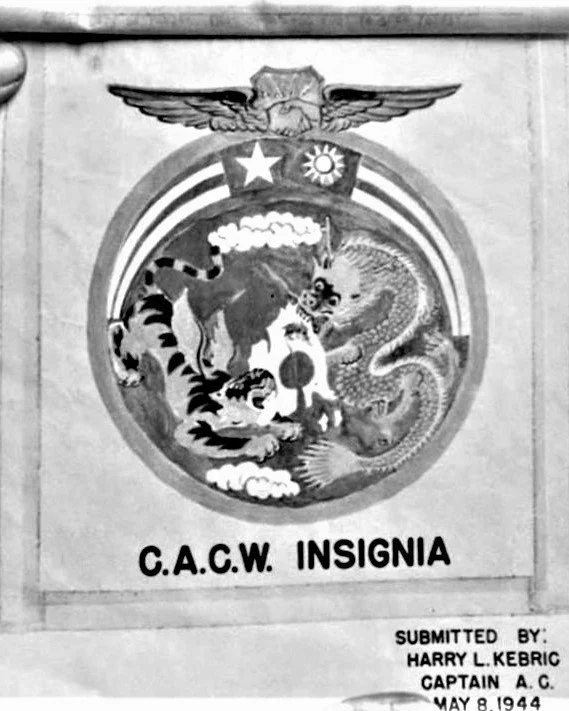
CACW Insignia: Symbol of Binational Alliance
It wasn’t until the year following activation of the Chinese-American Composite Wing that this one-of-a-kind unit adopted an insignia symbolizing its distinctive binational character. It featured an American “Flying Tiger” and a traditional Chinese dragon, shown symbolically destroying a “rising sun” flag that represented imperial Japan, their common enemy. Its design aptly reflected Maj. Gen. Claire Lee Chennault’s determination to provide good will and understanding between the Chinese and Americans for the future, as well as the CACW’s stated mission, "to train Chinese Air Force personnel in all phases of combat operations including maintenance and administration."

Back to the Z.I.
One of the hundreds of ships that transported veterans back home following the defeat of Japan in World War II, USS General George O. Squier departed Karachi on October 13, 1945. Passing through the Suez Canal and then heading west along the northern coast of Africa, it arrived at the Port of New York on November 2. TSgts James H. Mills and Robert N. Solyn, two of Squire's 3,343 passengers who passed through customs that day, were back home in time to celebrate Thanksgiving with their families.

Chennault’s Grand Experiment
Major General Claire Lee Chennault, in command of the 14th Air Force and formerly of the American Volunteer Group, envisioned and implemented his grand experiment--the Chinese-American Composite Wing. His purposes were to rehabilitate the Chinese Air Force fighting under Generalissimo Chiang Kai-shek, head of the Republic of China, and to provide good will and understanding between the Chinese and Americans for the future. The CACW proved to be enormously successful and played a key role in defeating the Japanese invaders.