
Driver’s Permit at Dergaon
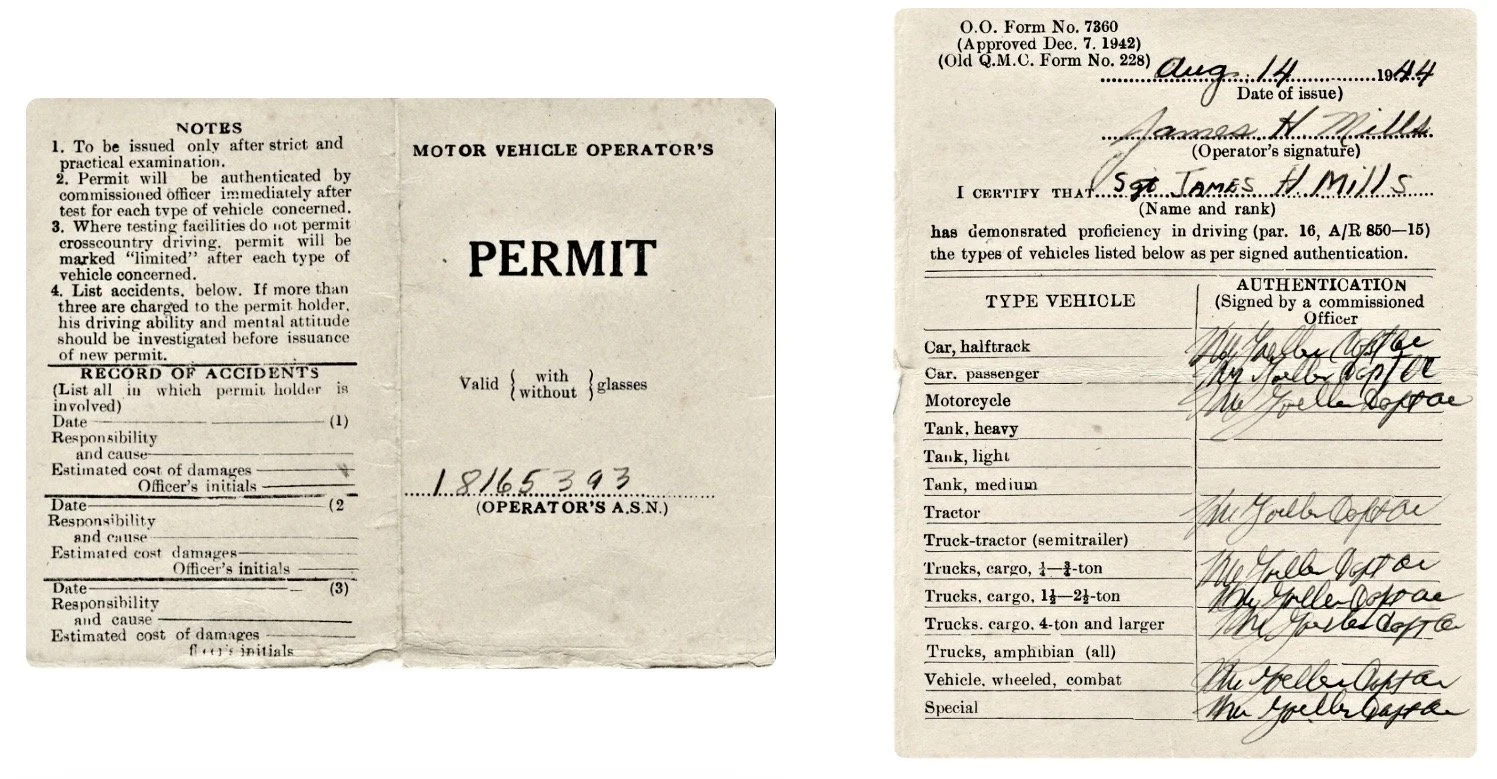
James H. Mills, my father, kept this “Motor Vehicle Operator’s Permit” in an old hatbox, along with photos and other mementos from his World War II service in the China-Burma-India theater. Investigation into the circumstances under which it was issued reveal some intriguing details, particularly regarding Captain Howard M. Goeller, who signed it.
On August 14, 1944, Sgt. James H. (“Hank”) Mills was issued a “Motor Vehicle Operator’s Permit” (O.O. Form No. 7360). According to provisions printed on the reverse, endorsement was required by a commissioned officer following “strict and practical examination” on each type of vehicle listed. Signed by Capt. Howard M. Goeller, squadron adjutant, the permit authorized him to drive half-track and passenger cars, motorcycles, tractors, cargo trucks (from ¼ ton to 4 ton and larger), wheeled combat vehicles, and “special.”
Like many events, the issuance of this permit has a backstory, and Capt. Goeller’s signature on that date raises some questions.
The Chinese-American Composite Wing’s 3rd Bomb Squadron, temporarily attached to the 10th Air Force, had relocated from Moran Field, Upper Assam, India, to Dergaon Field, about eighty miles farther to the southwest. Hank had experience with driving a weapons carrier, and he remembered transporting two Chinese pilots to the new base in one of these open vehicles when they encountered a full-grown Bengal tiger (but that’s a story for another time).
On this eventful day, American members of the squadron were invited to celebrate Chinese Air Force Day with their Chinese counterparts. This holiday is held annually on August 14 to commemorate the heroism and sacrifice of Chinese pilots in defense of their homeland on that date in 1937, when the CAF scored its first air-to-air victory over the Japanese invaders. It began early, with the entire squadron participating in a flag ceremony at 0800. Two Chinese generals and staff were guests of honor. Several large, inscribed banners were presented to the squadron’s American component to commemorate the occasion. Gen. Sun Li-jen, Division Commander, was guest speaker, followed by squadron commanders Maj. Wu Ch'ao-chen and Maj. Chester M. Conrad.
Squadron B-25s flew two missions that afternoon, but two of them failed to return. Maj. Conrad, with two high-ranking Chinese officers along as observers and carrying binational aircrews, led a nine-plane formation. They bombed and strafed the city of Mohnyin in northern Burma (now Myanmar) “with excellent results.” Conrad’s Mitchell encountered some antiaircraft fire, although no significant damage resulted.
Capt. Mark T. Seacrest led the second mission of the day, also carrying a mixed aircrew and two Chinese officers as observers. On his wing was a second B-25 manned by an all-Chinese aircrew. The two planes successfully skip-bombed a twin bridge about four miles northwest of Lashio, starting point of the Burma Road's south end, but both were forced down due to heavy enemy ground fire. All survived and rejoined their squadron, aided by Chinese civilians along the way.
When Maj. Gen. Claire Lee Chennault had initially proposed formation of the Chinese-American Composite Wing in 1943, his stated purposes were to rehabilitate the Chinese Air Force fighting under Generalissimo Chiang Kai-shek and to provide good will and understanding between the Chinese and Americans for the future. A month prior to signing Hank’s permit, Capt. Goeller had seriously violated that protocol in a moment of bad judgment. A glimpse into his background may provide some clues as to his actions.
Born in 1909, Goeller seems to have experienced a troubled childhood. Several notices in his hometown newspaper requested the public to be on the lookout for him after he went missing, only to later be discovered wandering miles away from his home. When he was six years old, he was hospitalized in critical condition because of a self-inflicted gunshot wound to the abdomen. When questioned, the boy explained that he was trying to shoot the rifle in the same way German soldiers were depicted in a film he had recently viewed. However, doubts persisted because the nature of the wound would have required that he use his foot to pull the trigger of the .22 caliber long rifle.
After graduating from high school and completing a year at Depauw University, Goeller made his way in the summer of 1930 to Galveston, Texas, where he signed on as a deck boy aboard Edgehill, giving his age as twenty-one instead of twenty. His thirst for adventure having been satisfied, he returned thereafter to Indiana, where his life was prosaic. He found employment as an accountant. Following his marriage two years later, he tried his hand at farming. In addition, he owned and operated the St. Denis Hotel and Laundry in Columbus with his brother Wallace.
Then came the attack on Pearl Harbor that changed the nation. In early 1942, he applied for a commission in the Army and was administered an oral examination to assess his qualifications. Addressed to him as first lieutenant, a telegram arrived in mid-June from the adjutant general’s office in Washington, DC, ordering him to leave on July 1 to report at the officers’ training school at Miami Beach, Florida. After the completion of training, Goeller was appointed base administrative inspector at Great Falls, Montana. In May 1943, he was named commanding officer at the Army Air Base at Glasgow, Montana, where he served until his move to the China-Burma-India theater (CBI). He arrived at Karachi, India, aboard USS Mission Bay on March 29, 1944, along with three other officers and eleven enlisted men that included then-Cpl. Mills. They were officially attached to the 3rd Bomb Squadron on April 3.
Capt. Goeller’s administrative experience qualified him to fill the position of adjutant and administrative inspector, tasked to distribute the commanding officer’s orders and ensure their compliance. Other duties were overseeing the general well-being of squadron personnel and keeping them combat ready, as well as monitoring completion of the monthly historical report and other records. Because Goeller was their senior in age, the other officers called him “Pop.”
He received praise when he shepherded a detachment of ground personnel for the move from Karachi to Moran. Capt. Louis F. Graves, Jr., squadron navigator and historical officer, wrote that they completed the journey on June 31, "after the twenty-day train ride across India's hinterlands.” The men were "fagged and war weary" and "fed up on Army rations and impromptu bedding and bounded by rail confines.” Nevertheless, all personnel arrived safely and in apparent good health, “a tribute to the efficiency of Capt. Goeller, squadron adjutant and travel master extraordinary who threatened many an Indian trainman with a 'kick in the ass' with success.”
It is ironic that Goeller was praised for threatening the behavior that later placed him under censure.
Although the squadron’s Chinese and American personnel generally got along well together because they were fighting a common enemy, occasional conflicts arose, some of them serious enough to require intervention by “brass.” Differing languages presented the most obvious and immediate difficulty, but complete disparities in ideology, philosophy, and culture also contributed toward strained relations between the two components. Maj. Don Hummel, formerly an attorney in Tucson and now CACW intelligence officer as well as historical officer, blamed the contrast between the Americans’ drive and need for immediate results with the Chinese tradition of patience and “politeness” for the misunderstandings that did sometimes arise. It was during this period the squadron was at Moran that another serious conflict arose. This time it involved the squadron’s adjutant and a Chinese sergeant.
Omitted from the squadron’s monthly historical report, the only details discovered came from the diary kept by Capt. Thomas S. Simpson, one of the squadron’s pilots. The events were related to him by two other officers after he returned from a hospital stay for treatment of malaria. “Pop Goeller had taken a Chinese boy by the nape of the neck and kicked him out of his tent. Big row—Chinese refused to fly. Conrad arrested Pop and confined him to his quarters—even has to have his food brought to him. What a life—Air Inspector from 10th A.F. came down. Pop is to be transferred to HQ 10th AF. Not bad for kicking a Chinese boy in the ‘A,’” Simpson wrote after learning of the incident.
The regrettable incident likely occurred on July 15, since the following day’s morning report noted that Sgt. Liu Ho-teh (X-2126) went from duty to the hospital. He returned to duty on July 19. Previously signed by Capt. Goeller, morning reports for the sixteenth and extending through the end of the month bore the signature of Maj. Conrad.
Goeller was moved to 10th Air Force headquarters at Chabua, where his contact with Chinese personnel was limited. While waiting for orders reassigning him, he was appointed to Summary Court Martial "for such cases as may be brought before him."
As squadron planes executed their final raids into Burma, Maj. Conrad at last received orders on August 16 for his squadron's movement to China. Capt. James C. Kelso, Jr., a former general office clerk for United Aircraft, Pratt and Whitney Division (manufacturer of airplane engines) in Hartford, Connecticut, was attached and assumed duties as adjutant to replace Capt. Goeller, who was officially released from duty on the same date. He was appointed Assistant Air Inspector. Later promoted to major, he served in that capacity until he returned to the US in late March 1945, after serving in the CBI for fourteen months.
Was Capt. Goeller allowed to take part in the August 14 celebration at Dergaon, or was his signature on Hank’s driving permit bearing that date obtained in some other way? Those questions may never have an answer.
There is much more to be discovered about this distinctive outfit and the men who made up its ranks. Find it now in The Spray and Pray Squadron: 3rd Bomb Squadron, 1st Bomb Group, Chinese-American Composite Wing in World War II!