
A Gift for Mother
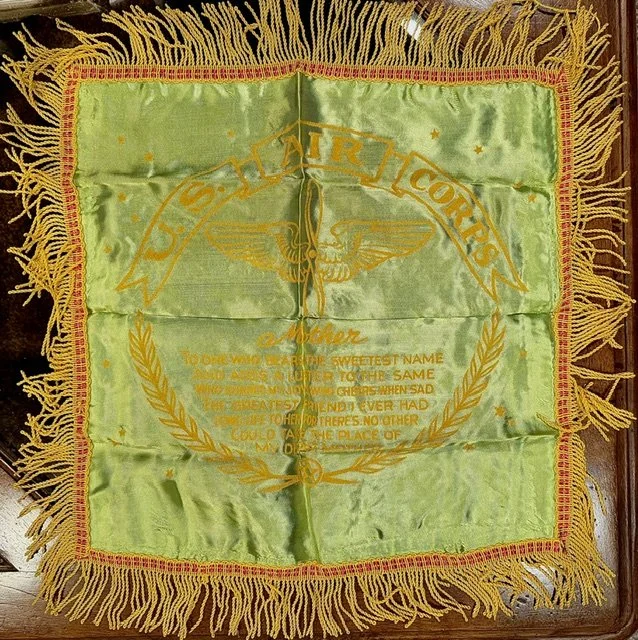
Made of lime-green satin stamped with flocked, gold lettering, this large pillow cover was typical of souvenirs shipped home by American GIs. My soon-to-be father sent it to his mother just before shipping out to the China-Burma-India theater. He intended it as a constant reminder of his affection for her while he was overseas, knowing it would likely be many months before he would return.
World War II history extends beyond the battlefield.
U.S. ARMY AIR CORPS
MOTHER
TO ONE WHO BEARS THE SWEETEST NAME
AND ADDS A LUSTER TO THE SAME
WHO SHARES MY JOY AND CHEERS WHEN SAD
THE GREATEST FRIEND I EVER HAD
LONG LIFE TO HER FOR THERE’S NO OTHER
COULD TAKE THE PLACE OF MY DEAR MOTHER
Decorative pillow covers were a favorite choice of souvenirs among soldiers during World War II, and my grandmother received several from her two sons who served in the US military. She kept them among her “treasures” for the rest of her life. This one came from the eldest of her three boys, (then) Cpl. James H. (“Hank”) Mills, who later became my father. (I was born about two months after he sent his gift.) No date was stamped on the box, although it was postmarked “Goldsboro, N.C.” Postage for letters was free to servicemen, but he paid six cents to have this package delivered. Even as he sent it, he understood the probability that he would not be with any of his family again until long afterward.
After completing a series of technical schools provided by the Air Forces Technical Training Command that qualified him as a B-26 Marauder crew chief, Hank had been sent to Seymour Johnson Field, located two miles southeast of Goldsboro. In addition to providing technical training throughout the war, the base had a unit known as the Provisional Overseas Replacement Training Center, intended to prepare officers and enlisted men for overseas duty. While stationed there, he received transition training to familiarize him with the B-25 Mitchell medium bomber.
Unknown to him at that time, Hank had been selected to serve in an elite organization that was the brainchild of Maj. Gen. Claire Lee Chennault. Already famous for his pre-war leadership of the American Volunteer Group (AVG), a small but effective mercenary force that gained fame as the “Flying Tigers”, Chennault had devised and implemented a plan that took his efforts to aid the Chinese in their fight against the Japanese invaders even further than before.
On February 14, 1944, Hank and others assigned to Squadron 4, 716 Training Group, boarded a train from Goldsboro that took them to New York City, a journey of about 500 miles to the north. After a few days at Fort Hamilton, they boarded USS Mission Bay, one of two escort carriers bound for the China-Burma-India (CBI) theater to join in the defense against expansion of Japanese imperialism in that part of the world. The carriers transported the first one hundred P-47 Thunderbolts (fifty strapped to the deck of each) to be sent to the CBI. The men on board knew only that they were destined for a secret location in the Far East.
At sea for a biblical “forty days and forty nights,” according to Hank’s recollections, the convoy (designated Task Force Group 27.2) went down and around the coast to South America, crossed the Atlantic, and then steamed up the coast of Africa to the Arabian Sea. This circuitous route was chosen because it was less likely to attract the attention of marauding Germans than if the ship had steamed directly east across the Atlantic and then along the coast of North Africa, as was the case when a convoy that carried personnel intended for the CBI had been hit by Luftwaffe bombers the previous November. Mission Bay entered the channel at Karachi, India (now Pakistan) at 0700 on March 29 and anchored off the breakwater to await the end of a dust storm. At 1625, the carrier was “moored port side to dock, Berth 21, West Wharf” and began discharging passengers and unloading cargo.
Soon after his arrival, Hank was sent to Malir Airdrome, located fifteen miles northeast of Karachi in North Malir Cantonment, out on the fringe of the Sindh Desert. On April 3, along with ten other enlisted men and four officers (all members of “Shipment AB-720-A”), he was attached to a B-25 bomber squadron of the Chinese-American Composite Wing. It was a military organization unlike any other in the world.
Envisioned by Chennault for the purpose of rehabilitating the Chinese Air Force fighting under Generalissimo Chiang Kai-shek, head of the Republic of China, and providing good will and understanding between the Chinese and Americans for the future, the unit integrated Chinese and American personnel at every level of command. “There was a squadron of Chinese attached to our squadron to learn from us how to operate the American planes,” Hank explained many years later. His specific responsibility was to train the Chinese airplane mechanics, using the latest in procedures and techniques.
Hank’s duties as a crew chief, responsible for the repair and maintenance of a single airplane, soon evolved to also include assignment as an aerial gunner on combat missions. By the time he returned to his home and family just before Thanksgiving in 1945, the CACW had been instrumental in aiding the Allies to win air superiority by disrupting enemy supply lines and supporting ground troops, and it played a vital role in defeating Japanese forces in China.
Learn more of this and other “behind-the-scenes” stories of America’s soldiers who fought far away from home to preserve freedom. Order The Spray and Pray Squadron: 3rd Bomb Squadron, 1st Bomb Group, Chinese-American Composite Wing in World War II today!