
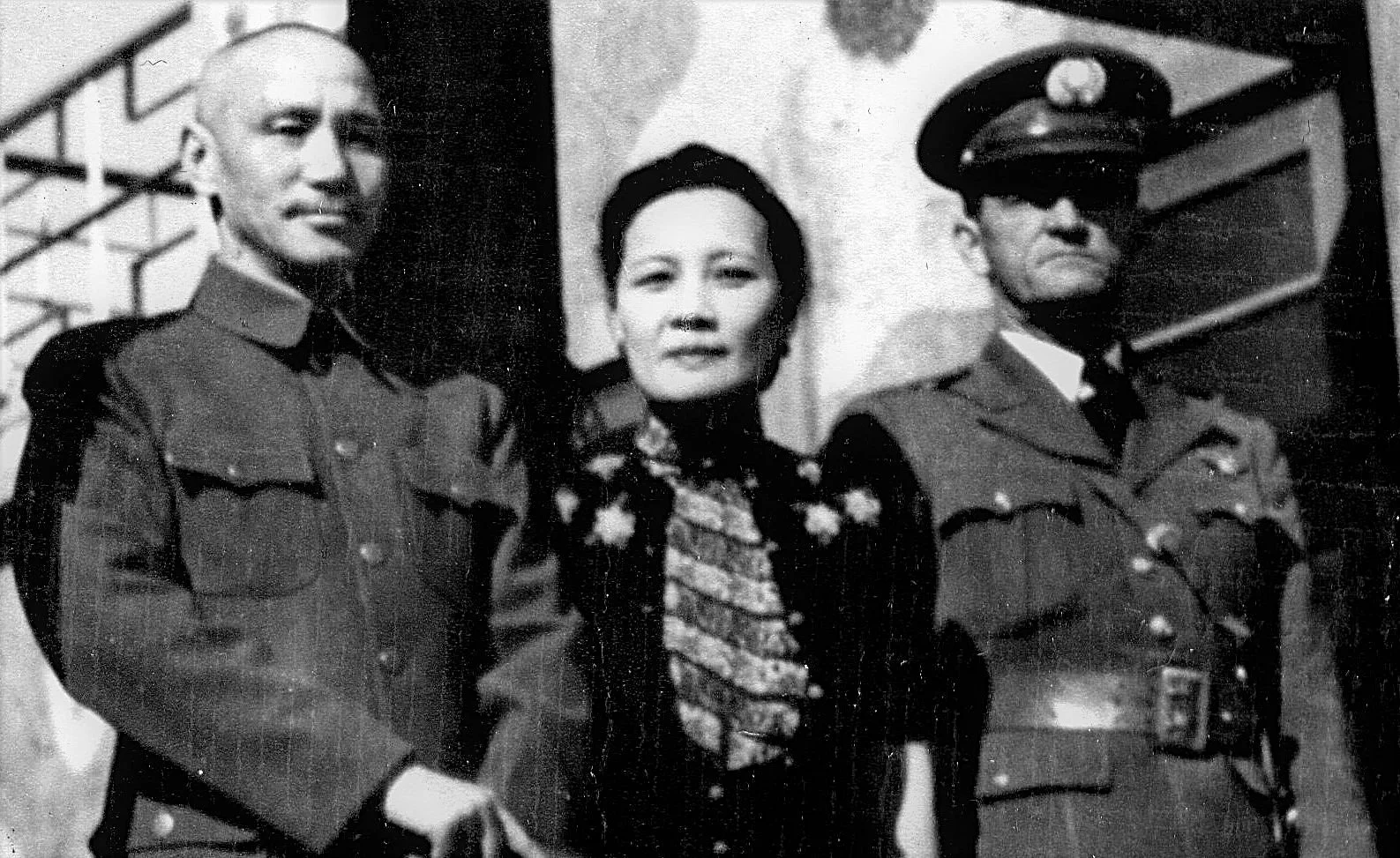
Major General Claire Lee Chennault, shown here with Generalissimo Chiang Kai-shek and Soong Mei-ling (also known as Madame Chiang), was acclaimed as the visionary leader of the renowned “Flying Tigers.” Known as a man of strong personality and unorthodox methods, he left behind a rich and enduring legacy. Chennault’s military career included a succession of outstanding achievements, as well as of deep disappointments. He was esteemed by the men who served under him, although criticized and overlooked by fellow strategists who considered the tactics of “defensive pursuit” he favored as obsolete. Blamed for the early losses of Allied bases to Japan, his 14th Air Force later gained air supremacy in the skies over China. Feuds involving other military leaders, particularly with General Joseph Stilwell, led to Chennault’s forced retirement in July 1945.
He was the author of an autobiography, Way of a Fighter, as well as several works on fighter tactics. Among his many decorations and orders were those awarded by the United States, the United Kingdom, the Republic of China, France, and Poland. Chennault was posthumously inducted into the National Aviation Hall of Fame in 1972. He has been commemorated by statues erected in Taipei, Republic of China (Taiwan), and Beijing, People’s Republic of China, and monuments were placed to honor him at Baton Rouge and Lake Charles, Louisiana. The Chennault Aviation and Military Museum, at Monroe, is operated by his granddaughter, Nell Calloway. — United States Air Force
"Under the leadership of Chennault, the planes of the smallest of all our Air Forces harass and smash relentlessly at the Japs. They support the ground forces of the fighting Chinese, deep in the hills where supplies are hard to come by and where Lend-Lease is unknown. In all sorts of weather, these pilots, both Yank and Chinese, continue the job of keeping China for the Chinese, strafing and bombing enemy columns, making sea sweeps, blasting military installations."
― Excerpt from "’Flying Trapezists' Together in China,” CBI Roundup, Vol. II, No. 45 (Delhi, India), July 20, 1944
Such praise was common for Claire Lee Chennault, a major general in the United States Army Air Forces by this time in the war. Renowned as a brilliant strategist, he surmounted seemingly-impossible odds to secure victory in the skies over China against invading imperial Japanese forces. This controversial commander known as "Old Leatherface" was beloved by the men who served under him and esteemed in both the United States and China, but he often ran afoul of other military leaders who lacked confidence in his innovative ideas and who favored their own agendas.
Born on September 6, 1893, in Commerce, Texas, Chennault spent his boyhood in Gilbert, Louisiana, and underwent Reserve Officers’ Training Corps (ROTC) training while attending Louisiana State University. Afterward he became the teacher for a one-room school. At the onset of World War I, he graduated from Officers' School and was transferred to the Aviation Division of the Army Signal Corps. His aim was to become a pilot, but hostilities ended before he was granted his wings―rejected three times because he did not possess the necessary qualifications to be an aviator, according to his superiors. On his fourth attempt, Chennault was accepted and received his first wings on April 9, 1919. Graduating from pursuit pilot training in 1922, he remained in the service after it became the Army Air Corps in 1926 and was appointed Chief of Pursuit Section at Air Corps Tactical School in the 1930s.
During those post-war years, Chennault honed his skills as an aerobatic flyer of biplanes. In the lead of a three-man team called the "Three Musketeers," he performed intricate aerial maneuvers at events across the country, including the National Air Races in 1928. In 1932, as a pursuit aviation instructor at Maxwell Field in Alabama, Chennault reorganized the team as "Three Men on a Flying Trapeze," which continued to perform for awe-struck spectators below. By 1937, Chennault had served twenty years in the military but was repeatedly passed over for promotion. Citing health problems―chronic bronchitis and partial deafness from many years of open-cockpit flying―he resigned from the Air Corps with the rank of captain and the aerobatics team was disbanded.
Soon afterward, he accepted an invitation from Chinese Nationalist leader Generalissimo Chiang Kai-shek (extended at the urging of Madame Chiang, the Generalissimo’s pro-western wife) to go to China to survey the ineffectual Republic of China Air Force―and thus began Chennault's second military career for which he became best known. At that time most Americans, including President Franklin D. Roosevelt, were opposed to all overseas military involvement.
When Chennault arrived in China in June 1937, he discovered that the occupying Japanese were committing atrocities against its defenseless civilian population that matched the brutality of Hitler's Nazis in Europe, plundering, torturing, raping, and killing with impunity. Japanese planes bombed Kunming and the surrounding area almost daily for target practice, and the Chinese Air Force could do little to deter them. It became Chennault's mission to transform the ROCAF into an effective fighting force capable of fending off the invaders. Under paid contract, he became Chiang Kai-shek's chief air adviser, training Chinese pilots according to the American model as well as participating in occasional scouting missions.
Chennault returned to America in 1941 and recruited a group of men from the Army Air Corps, Marines, and Navy that formed the American Volunteer Group (AVG). The mission of this small band of mercenaries based in Burma was to fly P-40s, using Chennault's tactics of "defensive pursuit" to shoot down Japanese aircraft in an effort to aid the Chinese in their fight for survival. This was a new strategy that was met with great resistance by the majority of military leaders at a time when bombers were generally faster than pursuit planes.
It was not until after the Japanese attack on Pearl Harbor in December 1941 that the AVG went into action in earnest. Within days, Chennault’s airmen began attacking ground targets and engaging enemy aircraft throughout the China-Burma-India (CBI) Theater. Their primary objective was to protect the vital Burma Road, but the unit also guarded Rangoon and other strategic locations in Southeast Asia and western China against Japanese forces. The AVG proved to be enormously successful and racked up a series of impressive victories over the invaders. Two weeks after their first mission came the earliest news reports praising Chennault and his fearless flyers, and soon Chinese newspapers followed by the American press began referring to them as the "Flying Tigers.” Their exploits quickly assumed legendary proportions, and Chennault became a hero as their daring leader.
The AVG launched missions against the Japanese for seven months. Chennault, who returned to active duty in the United States Army Air Forces in April 1942 with the rank of colonel, was promoted soon afterward to brigadier general. Opposed to inducting his Flying Tigers into the Army, he feared that turning his group into a regulation military unit would reduce its effectiveness. However, top brass had no intention of supporting a private air force that functioned outside of military channels after the US entered the war.
At midnight on July 4, 1942, the American Volunteer Group ceased to exist. Replaced by the China Air Task Force (CATF) and formally inducted into the USAAF, the group continued to be called the Flying Tigers. Because of the Japanese occupation of Burma in early April, the mission of the CATF was to defend the air supply route over the Himalayan Mountains between India and China―known as "the Hump"―as well as to provide air support for Chinese ground forces. Stationed in India, the task force (flying both fighters and bombers) operated under Chennault's command as part of the 10th Air Force, which controlled supplies, personnel, and operations. With few resources available to fight a powerful enemy deployed across a vast front, the CATF achieved a combat record that proved it to be a worthy successor to the AVG.
The CATF was in existence for nine months. On March 19, 1943, it was disbanded and replaced by the recently-established 14th Air Force. Chennault, now a major general, was placed in command. The 14th Air Force, under his leadership, continued the Flying Tigers legacy and went on to win air superiority in China. Chennault remained in command until July 1945, when he again retired―forced out once more because of his controversial methods and outspoken criticisms. By the end of the war, the 14th Air Force had more than 20,000 men and 1,000 planes in China that played a vital role in the defeat of Japan. Key among them was the unique Chinese-American Composite Wing, which took Chennault's plan to assist the Chinese even further than his previous efforts.
After the war, Chennault returned to China. He purchased several surplus military aircraft and established the Civil Air Transport (later known as Air America). These aircraft facilitated aid to Nationalist China during the struggle against the Chinese Communists in the late 1940s and were later used in supply missions to French forces in Indochina and the Kuomintang occupation of northern Burma throughout the mid- to late-1950s.
Chennault was finally promoted to lieutenant general in the United States Air Force on July 18, 1958, only nine days before his death on July 27 as the result of lung cancer. He was interred at Arlington National Cemetery.
Without this unconventional and courageous leader, the events that unfold within these pages would never have been accomplished.
I used this as the Preface for my book, which has been praised by a prominent author of World War II history as “one of the most thoroughly researched and highly detailed unit histories of a single air squadron ever published.” You can find The Spray and Pray Squadron: 3rd Bomb Squadron, 1st Bomb Group, Chinese-American Composite Wing in World War II available at most online book vendors.